Wyrm Loader
The implant primarily is prepared to be a reflective DLL which means it can load itself when a thread is spawned over its reflective entry.
Currently, the reflective entrypoint is the export Load, meaning the PE must be mapped into memory, and then a thread runs over Load. The Load export is fully ‘context’ independent and does not rely on the standard library, meaning nothing needs to be set up specially for it to work.
The loader packs the Wyrm post exploitation payload into an encrypted region of memory which when compiled, is placed into the .text section of the binary, not into .rdata. This was chosen as EDR’s typically scrutinise the .rdata and similar sections for signs of packed / encrypted binaries / high entropy, etc. This in theory should make the payload more resilient against EDRs.
At compile time when the loader is built, it also stomps the DLL signatures of the rDLL section again, to help combat EDR’s looking too closely at signs of rDLL injection.
The rDLL (still at compile time) is XOR encrypted using the NOP OPCODE (0x90) in place. This was chosen as it’s a very common OPCODE in the .text section so should help the encrypted payload to blend in, albeit it now is invalid assembly. I will be interested if the Red Team / pentest community try this out against EDR’s to see how it fairs.
When the loader runs, it will begin by allocating memory in its own process and it will decrypt the PE (with stomped headers) as below:
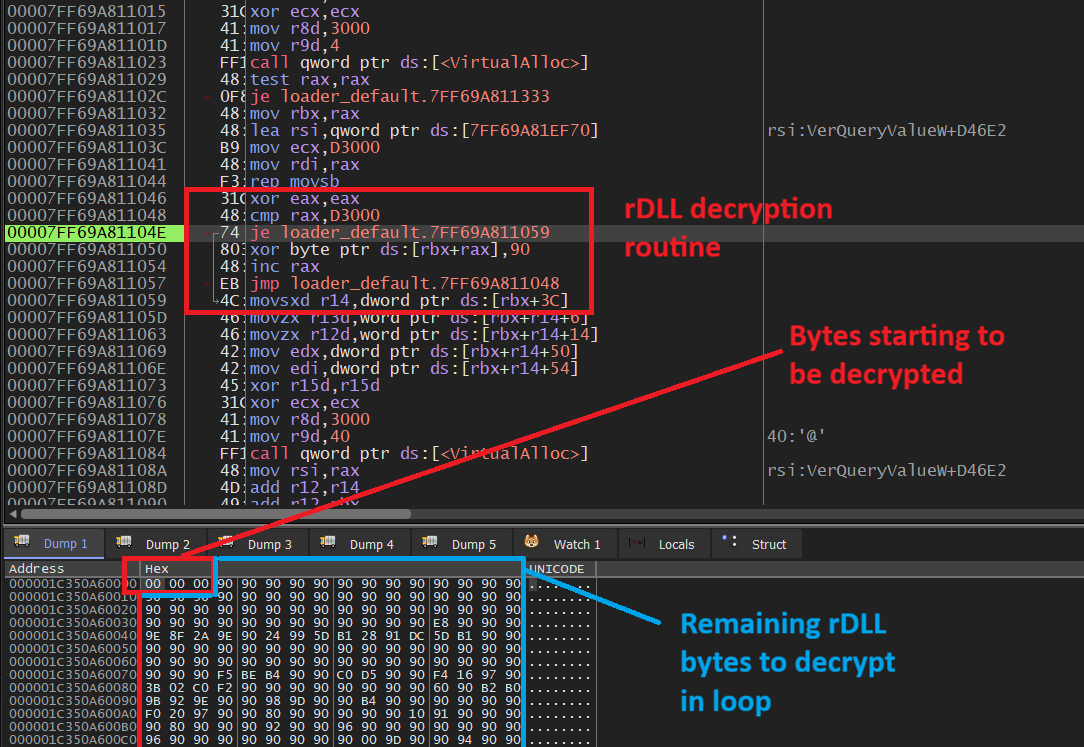
The loader will then resolve the relevant exports, and jump to the Load export, which is ‘context’ independent in that execution can arbitrarily start from that location. The thread of execution will then resolve and realign the DLL, and it can run as normal.
Visualised:

Using the reflective loader
If you wish to manually build an injector / make it work with existing tooling, then you can map the Wyrm DLL (not the loader version) into memory however you like. Then you need to find and call the Load export (can do this by resolving the headers at the start of the PE).
When you go to call the Load function, you must pass a parameter which is the base address of the allocation where the Wyrm rDLL lives. You can do this across FFI boundaries (e.g. from C/C++).
The function signature for Load is:
pub unsafe extern "system" fn Load(image_base: *mut c_void) -> u32
So you must satisfy this. An example call (in Rust, but feel free to use C/C++) is:
// Allocate memory
let p_alloc = VirtualAlloc(
    null_mut(),
    nt.OptionalHeader.SizeOfImage as usize,
    MEM_COMMIT | MEM_RESERVE,
    PAGE_READWRITE,
);

// Fill the memory + set PAGE_EXECUTE_READWRITE
// ..

// Resolve the function pointer for the Load export
// ..

// Now call that function pointer, passing in the base address of the allocation
load(p_alloc);